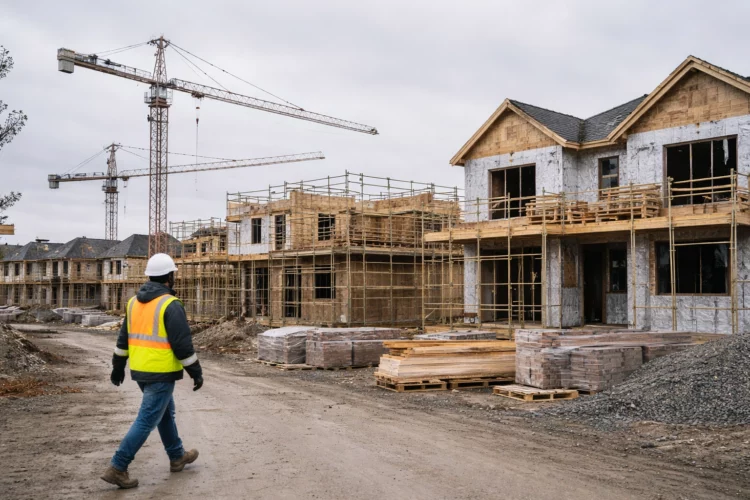
For decades, new home construction has been one of Ontario’s most reliable economic engines. It has supported hundreds of thousands of jobs, generated billions in wages and tax revenue, and played a central role in housing a rapidly growing population. That engine is now stalling, and the data from 2025 make it clear that this is no longer just a housing affordability issue.
Ontario is facing a deep structural slowdown in new home sales and construction that threatens employment, future housing supply, government finances, and the province’s long-term economic stability. What is unfolding is not a short-term dip or a cyclical pause. It is a breakdown in the housing pipeline with effects that will be felt for years.
Why New Home Construction Matters to Ontario’s Economy
Housing is not a single industry. It is a complex economic ecosystem that touches construction trades, manufacturing, professional services, transportation, finance, and municipal infrastructure.
A Sector Built on Long-Term Planning
New housing follows a pipeline that often stretches close to a decade. Projects typically begin with land acquisition, planning, design, and regulatory approvals. Pre-construction sales usually start midway through that process, followed by construction starts and, years later, completion and occupancy.
At any moment, the number of homes moving through this pipeline determines how much construction activity is happening across the province. When sales slow sharply, fewer projects move forward, fewer homes get built, and fewer workers are needed. The effects compound over time rather than correcting quickly.
Housing as an Employment Anchor
Residential construction has long been one of Ontario’s most dependable sources of employment. The sector does not just support builders and tradespeople, but also architects, engineers, material suppliers, truck drivers, and countless service roles tied to construction spending.
When housing stalls, the impact ripples across the entire economy.
New Home Sales Have Collapsed to Historic Lows
The most alarming signal comes from sales data. Across Ontario, new home sales in 2025 fell to levels not seen since record-keeping began in 1981.
Province-Wide Sales at a Fraction of Normal Levels
In 2025, approximately 15,000 new homes were sold across Ontario. Historically, annual sales typically ranged between 65,000 and 85,000 units. This is not a mild slowdown. It is a collapse in demand that leaves large sections of the development pipeline empty.
The GTA Is Experiencing an Unprecedented Slump
The situation is even more severe in the Greater Toronto Area. In 2025, total new home sales fell to just 5,314 units, the lowest level ever recorded.
Single-family home sales dropped 63 percent below their 10-year average. Condominium apartment sales fell by an astonishing 89 percent. These figures signal a market that has effectively seized up, particularly in the segment that has historically delivered the bulk of new housing supply.
Housing Starts Are Now Following Sales Downward
Sales declines do not immediately show up in construction numbers, but they eventually do. The latest housing starts data confirm that this downturn is now moving from the sales side into construction activity.
Ontario Housing Starts Are Falling Sharply
According to data from the Canada Mortgage and Housing Corporation, Ontario recorded 62,561 housing starts in 2025. That is down from 72,118 starts in 2024, a year-over-year decline of 13 percent.
This drop is especially concerning because housing starts today reflect sales decisions made years earlier. With sales now at record lows, the pipeline of future projects is shrinking even further.
A Looming Supply Shortfall
By 2030, annual housing starts in Ontario are projected to fall to roughly 40,000 units, including purpose-built rental housing. That is down from about 80,000 units today. This decline is occurring even as population growth remains strong, setting the stage for severe future housing shortages.
Employment Losses Could Be Massive and Long-Lasting
The housing construction sector has been a critical employment stabilizer for Ontario, particularly during periods of broader economic uncertainty.
The Scale of Jobs at Risk
From 2020 to 2024, new home construction supported an average of 222,700 jobs annually across Ontario. This included more than 104,000 direct construction jobs, nearly 73,000 indirect jobs in related industries, and over 45,000 induced jobs supported by worker spending.
If current trends persist, Ontario could lose roughly 100,000 jobs from a residential construction workforce of about 225,000. This would represent one of the largest employment shocks the province has faced in decades.
Wage Losses Will Hit Communities Hard
By 2030, the slowdown could result in nearly $13 billion in lost wages and earnings. These losses would be felt far beyond construction workers, affecting local businesses, service providers, and regional economies that depend on construction-related spending.
Government Revenues Are at Serious Risk
The housing sector is a major contributor to public finances at every level of government. A prolonged slowdown threatens a significant and sustained drop in revenue.
Billions in Annual Tax Losses
As construction activity declines, provincial GDP contributions from housing are projected to shrink from $31.7 billion annually to just $10.4 billion.
Governments could face combined annual revenue losses of approximately $8.5 billion. This includes losses from provincial sales tax, income tax, land transfer tax, and municipal development charges and fees.
These are not abstract numbers. Reduced revenue directly affects funding for infrastructure, healthcare, education, and social services.
Future Housing Supply Is Being Choked Off
One of the most dangerous consequences of the current slowdown is its effect on future housing availability.
Fewer Projects Today Mean Fewer Homes Tomorrow
When projects fail to enter the pipeline now, the shortage does not appear immediately. It shows up years later when population growth continues but housing completions lag far behind demand.
This creates a cycle where affordability worsens even further, making it harder to restart construction later.
The Risk of a Prolonged Structural Shortage
Without intervention, Ontario risks entering the next decade with chronically low housing supply, elevated prices, and even greater barriers to homeownership and rental affordability.
Why This Is No Longer Just a Housing Issue
The data make it clear that Ontario’s housing slowdown is no longer confined to real estate markets.
A Broader Economic Threat
The scale of job losses, wage declines, GDP contraction, and lost public revenue elevates this situation into a province-wide economic emergency. Left unaddressed, it could weaken Ontario’s economic foundation for years.
Confidence Is Breaking Down
Housing markets rely heavily on confidence. When buyers retreat, developers pause projects, lenders tighten conditions, and municipalities lose development revenue. Rebuilding confidence takes far longer than losing it.
One Immediate Policy Lever That Could Help
Among the most impactful short-term measures available is removing the HST from new homes.
How Sales Tax Relief Could Restart Activity
Eliminating the HST would immediately lower the cost of new housing, making projects more viable and restoring affordability for buyers. This could help unlock stalled developments and bring buyers back into the market.
Why Timing Matters
Delays in action mean further erosion of the construction pipeline. The longer sales remain depressed, the deeper the future supply gap becomes.
The Bottom Line for Ontario’s Economy
Ontario’s housing slowdown has crossed a critical threshold. What began as a market correction has evolved into a systemic economic risk with far-reaching consequences.
New home construction is not just about affordability. It is about jobs, government revenue, economic growth, and the province’s ability to support a growing population. Without decisive action, Ontario faces a future of fewer homes, fewer jobs, weaker public finances, and a prolonged drag on economic performance.
This is no longer a warning sign. It is an emergency that demands immediate and coordinated policy response.