A new report is putting Canada’s growing wealth divide back in the spotlight, and the numbers are hard to ignore. According to Oxfam, billionaire wealth in Canada and around the world surged in 2025, reaching record levels while millions of people struggled with rising costs, housing pressure, and food insecurity.
The report argues this isn’t only an economic issue anymore. It’s becoming a political one, with the richest individuals gaining outsized influence over laws, taxation, and public priorities. In Canada, Oxfam Canada says the country’s richest billionaires now control wealth comparable to the entire economic output of some nations, even as poverty has been rising since 2020.
This article breaks down what the report claims, what it means in real terms for Canada, and why the debate around wealth taxes, offshore tax havens, and political influence is expected to intensify in 2026.
The Global Picture: Billionaire Wealth Reached a New Record in 2025
Oxfam’s report paints 2025 as a year when the world’s richest people pulled even further ahead, not only increasing their wealth but expanding their numbers.
Wealth Grew by Trillions in a Single Year
According to the report, billionaire wealth worldwide rose sharply in 2025, increasing by trillions of U.S. dollars to reach a new record total. Oxfam argues that this surge is not just impressive growth at the top, but an extreme concentration of wealth that is reshaping economies and political systems.
From Oxfam’s perspective, this level of wealth accumulation is significant because it exists alongside widespread global hardship. The report claims that the scale of billionaire wealth growth could fund major poverty reduction efforts many times over.
The World Now Has More Than 3,000 Billionaires
Another milestone highlighted in the report is the number of billionaires worldwide surpassing 3,000 people for the first time. This matters because it signals a structural shift, not just a temporary spike.
Oxfam’s argument is that when billionaire wealth becomes this widespread and this large, it changes the balance of power in society. Wealth doesn’t just buy luxury. It buys influence, access, and the ability to shape rules.
A Small Group Holds More Than Half the World Combined
One of the report’s most striking claims is that the wealth of the very richest billionaires is now greater than the combined wealth held by the poorer half of the world’s population. That comparison is meant to show how unequal global wealth distribution has become.
Whether someone agrees with Oxfam’s framing or not, the comparison helps explain why inequality has become a central political issue in many countries, including Canada.
Oxfam’s Core Warning: Wealth Is Turning Into Political Power
Oxfam’s report isn’t just a list of numbers. It is a warning about what happens when wealth concentration becomes so extreme that it starts to distort democracy.
Billionaires and Political Influence
The report argues that billionaires are far more likely than average citizens to hold political office and influence political outcomes. That influence can show up in different ways, including:
Funding political campaigns
Lobbying and policy advocacy
Owning media and shaping narratives
Financing think tanks and research groups
Supporting industry groups that push legislation
Oxfam’s position is that these forces can shift public policy away from the needs of average people and toward the interests of the ultra-wealthy.
Why This Creates a “Political Deficit”
The report suggests that rising inequality creates a dangerous feedback loop. As wealth concentrates, political influence concentrates too. That can weaken trust in government and lead to anger, polarization, and instability.
Oxfam argues that when people feel they are falling behind financially and have no real voice politically, frustration grows fast. The report frames this as a major risk to social stability.
Billionaire Wealth in Canada: The Numbers Driving the Debate
While global inequality is enormous, the Canadian data in Oxfam Canada’s report is what makes the issue feel local and immediate.
Canada Has at Least 89 Billionaires
Oxfam Canada estimates that Canada has at least 89 billionaires. The report focuses on what that means in a country that prides itself on fairness, social mobility, and strong public institutions.
The number itself is less important than what it represents: a growing class of ultra-wealthy individuals whose wealth has expanded rapidly in recent years.
Canada’s Top 40 Wealthiest Grew to Nearly C$550 Billion
Oxfam Canada’s report says the wealth of Canada’s 40 richest people rose by more than 20 percent in 2025, reaching nearly C$550 billion. It compares this to the GDP of several countries, suggesting that a very small group of Canadians now holds wealth comparable to entire national economies.
That comparison is meant to highlight scale. GDP measures the value of goods and services produced by a country in a year. When personal wealth rivals that output, it signals extraordinary concentration.
The Richest One Percent Hold Nearly as Much as the Bottom 80 Percent
Another key claim in the report is that Canada’s richest one percent now hold almost as much wealth as the bottom 80 percent combined. This is a major statement because it suggests that wealth distribution is not just uneven, but heavily skewed toward a small group.
If accurate, it implies that economic gains are being captured at the top far faster than they are spreading through the broader population.
Rising Poverty and Food Insecurity: The Other Side of the Wealth Story
Oxfam’s argument becomes more emotionally powerful when it connects billionaire gains to the lived reality of everyday Canadians.
Poverty Has Been Rising Since 2020
The report claims poverty in Canada has been rising steadily since 2020. This matters because it challenges the idea that economic growth automatically improves life for everyone.
In a country with strong institutions and social programs, rising poverty suggests deeper pressures, such as housing affordability, low wage growth, and the rising cost of essentials.
Food Insecurity Is Becoming More Common
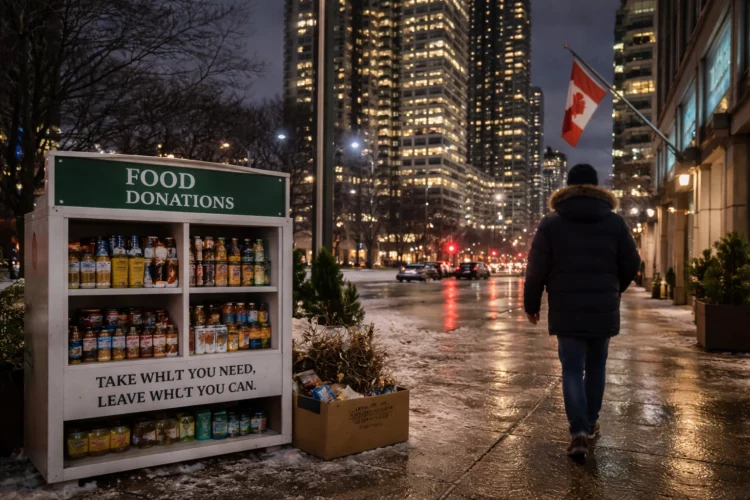
Oxfam Canada reports that about one quarter of Canadians now live in food-insecure households and regularly have to skip meals. Food insecurity has become one of the clearest indicators of economic stress, because it reflects the inability to afford basic nutrition.
Even if inflation slows, food prices and housing costs can remain high enough to keep families under pressure.
Why This Gap Feels Bigger Than a Typical “Wealth Divide”
Oxfam describes the situation as more than a normal wealth gap. The report argues that when wealth becomes extremely concentrated, the consequences are not only economic, but social and political as well.
This can show up in:
Reduced trust in institutions
Lower belief in fairness and opportunity
Higher tension between social groups
Growing pressure on public services
In short, the report suggests inequality is now shaping the entire national mood.
What Oxfam Canada Wants the Government to Do in 2026
The report doesn’t just criticize the current situation. It also pushes specific policy solutions that could become bigger topics in Canadian politics.
A Wealth Tax Targeting the Ultra-Rich
One of Oxfam Canada’s main recommendations is a wealth tax aimed at the richest individuals. The idea is to tax extreme net worth, not just annual income.
Supporters argue this could:
Reduce wealth concentration
Increase funding for public services
Improve fairness in the tax system
Critics often argue wealth taxes are difficult to implement, may encourage capital flight, and can be complex to enforce. Still, the topic is likely to grow as inequality becomes harder to ignore.
Cracking Down on Offshore Tax Havens
Oxfam also calls for stronger action against offshore tax strategies. The argument is that billions in potential tax revenue are being lost through complex structures that move money out of reach of Canadian taxation.
If governments can recover more revenue, Oxfam argues, Canada could fund stronger programs in areas like healthcare, housing, and poverty reduction without increasing the burden on average earners.
Rebalancing the System Toward Public Priorities
The broader message from Oxfam is that governments should prioritize:
Affordable healthcare access
Climate action and environmental protection
Tax fairness and enforcement
Stronger protections for workers and families
Whether one agrees with the organization’s approach or not, the political reality is that these themes are increasingly shaping public debates.
The “Trump Effect” and Why Oxfam Connects It to Wealth Growth
Oxfam links the acceleration of billionaire wealth growth to global political trends, including U.S. policies that benefit high earners and corporations.
Faster Billionaire Wealth Growth After Late 2024
The report claims billionaire fortunes have grown at a faster rate since late 2024, and it connects that trend to tax cuts and deregulation policies. While the strongest gains may have been in the United States, Oxfam argues the effect has spread globally, with double-digit billionaire wealth increases in many regions.
Why U.S. Policy Can Affect Canada Too
Canada’s economy is deeply connected to the U.S. through trade, investment flows, and financial markets. When U.S. policies increase returns for capital and corporate wealth, it can influence global markets in ways that also benefit wealthy asset holders in Canada.
This doesn’t mean U.S. policy is the only driver, but it can act as a tailwind for global wealth concentration.
Why This Report Matters for Canada’s Future
Even if you don’t follow billionaire rankings, the consequences of inequality show up in daily life.
Housing, Healthcare, and Social Stability
When wealth concentrates at the top, pressure builds in areas like:
Housing affordability
Access to quality healthcare
Education and opportunity
Public infrastructure funding
Trust in government
Oxfam’s core message is that inequality is not just unfair, it is destabilizing.
The Risk of Anger and Polarization
One of the report’s strongest warnings is that economic hardship creates hunger, but political exclusion creates anger. That anger can become political volatility, social division, and rising distrust in democratic institutions.
Canada has historically avoided the extremes seen elsewhere, but rising costs and growing inequality are testing that stability.
Final Takeaway: Billionaire Wealth Is Rising, and Canada’s Inequality Debate Will Get Louder in 2026
Oxfam’s new report argues that billionaire wealth in Canada is reaching levels that are difficult to justify in a country where food insecurity is rising and affordability is becoming a daily struggle for many families.
The report’s main claim is that extreme wealth is no longer just a financial issue. It is becoming a political one, with the power to shape laws, priorities, and public outcomes. In 2026, the pressure for reforms such as wealth taxes and tougher enforcement against offshore tax havens is likely to grow, especially as Canadians demand solutions that make life more affordable and restore confidence in fairness.
Whether policymakers act quickly or not, one thing is clear: the conversation around wealth concentration in Canada is no longer on the sidelines. It is moving to the centre of the national debate.